
HANGING WITH JAMES KOCHAN (MAINE ANTIQUES DIGEST, Sept. 2023)
August 24th, 2023
by Julie Schlenger Adell
Historian, archaeologist, outdoorsman, scholar, gentleman—all are appropriate descriptives for dealer James L. Kochan, who for the last seven years has been based in Wiscasset, Maine.
Before his move north, the former museum and national park director and curator lived in the Washington, D.C., area, most recently in Frederick, Maryland, where he had a gallery from 2005 to 2016. He started his business in 1998 in Shepherdstown, West Virginia.

This selfie was taken before a Halloween party at a neighbor’s house last year. James and Kim dressed up as the Marx brothers. “Being a bit of a hat and costume collector, we had props ready,” noted James. He deals in early American portraits and miniature portraits, maritime art, manuscripts, and antique arms and militaria, from Colonial America through 1850. “I’ve always loved costumes!” His collecting interest includes movie costumes and early uniforms.
The move to Wiscasset came after too many hot and humid summers in the D.C. area, he explained. The allure of a “green ethos,” including farm-to-market food, water sports, cultural activities, and a vibrant antiques area, sealed the deal for him and his partner, Kim, a retired knitwear designer. They have been together since 2009. Kim handles graphic design for Jim’s advertisements and the layout of his printed catalogs. His website (www.jameskochan.com) has recently been relaunched. Instagram is in the works, he said. “Kim has a great aesthetic,” he added.
Born in Lorain, Ohio on the south shore of Lake Erie, James would visit historic sites and museums with his family, which might explain why he went on to study history and historic archaeology. “I read a lot and liked camping. We were an outdoor family,” he said.
He specializes in early American portraits and miniatures, maritime art, manuscripts, and antique arms and militaria, focusing primarily on Colonial America to the War of 1812. “Everything cuts off at 1850,” he noted.
James opened his gallery in Wiscasset when he first moved to Maine but closed it not long after downtown traffic was redirected and “parking went away.” Several other dealers in town closed their shops as well.

In the 1840s, landscape artists, including Alvan Fisher, traveled to Mount Desert Island and its environs to work. This painting by Fisher (1792-1863), View from the Outlet of Long Pond. Island of Mount Desert, Maine, had been in the same family for close to 100 years when James acquired it in 2020. His conservator removed the yellowed varnish layer; the frame is currently at his frame conservator. It is signed and dated on the rock in the foreground. “It is one of my favorite works from the 1840s,” he said.
He has dropped every show except the annual Delaware Antiques Show in November and the Antiques in Manchester, New Hampshire, event in August.
Some 50% of his business comes from the museum world. Living in Wiscasset is ideal for getting to Portland—a 45-minute drive—and to Rockland and the Farnsworth Art Museum and others.
“I didn’t collect much when I was a curator, but by collecting you develop a sixth sense, and you’re a lot more careful. When your own money is on the line, you learn! There are incredible forgeries out there,” he stated.
Kochan said having his first gallery was a learning experience. “I had no business plan. My philosophy was ‘buy what you like, and hope others do.’ I never had a client list per se. I’m not a born salesman. I must be enthusiastic about something,” he said, adding, “With my history background, I like the stray dogs. If there’s great history and something’s in rough condition, but it’s a rarity tied to an event or personage, it’s spectacular!”

This silver medallion in the form of a bookplate of the Stephen Decatur family is by Henry Dawkins (fl. c. 1753-c. 1786). It is one of Kochan’s top ten favorite pieces. Dawkins, a leading engraver in Philadelphia in the 18th century, was sentenced to death for counterfeiting Continental currency, but his sentence was commuted, explained James, and instead he worked as an engraver and artisan for the Continental Army and Congress during the war. Kochan continues his research on the Decatur family members.

Kochan has an extensive reference library of over 10,000 volumes, with 1000 rare books from the 18th and early 19th centuries. Most are related to military and naval history, exploration, costume, and technology, he said.

A wall in the couple’s living room or “great room,” which overlooks the river. The desk is an antique drawing table. The portrait over the desk depicts Jim’s late canine companion Bailey, a golden-border collie rescue. The marine painting by James Pringle, 1835, is of the Philadelphia, a clipper ship of the Black Ball Line, on her maiden voyage from the United States to Great Britain. The watercolors, 1890s, are by Mary Bradish Titcomb (1858-1927), an artist whose work the couple admires. Other paintings, not shown, hang on the opposite wall.

James never thought of himself as a birdwatcher until moving to his current house. “There are more than two dozen different species at our birdfeeder—woodpeckers, mourning doves, finches, wrens, cardinals, jays,” he said. “Hummingbirds zoom around the garden, and bald eagles, osprey, and hawks fly overhead. Geese, ducks, and seabirds on the water.” Seen here is a framed, over 7' high hand-colored blockprint of cedar waxwings by Wiscasset artist R. Keith Rendall. In Kochan’s Frederick, Maryland, federal townhouse the ceilings were 13' high, and there were many walls to fill with art. He has traded those wall spaces for walls of windows overlooking the Sheepscot River. On the wall behind the granite hearth is a framed watercolor of chickadees by Mary Bradish Titcomb. “So artworks of birds vie with landscapes and seascapes in the home proper,” said Kochan.
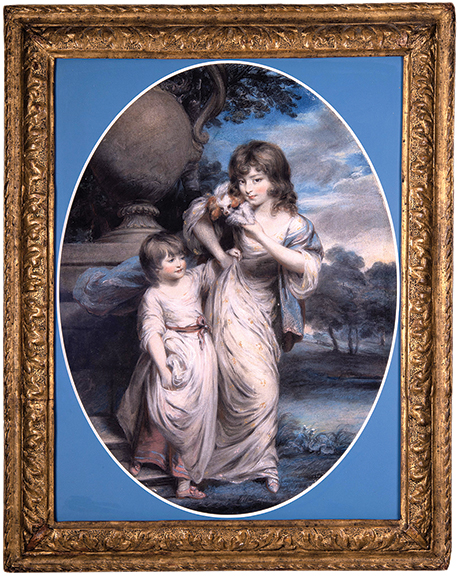
British paintings from the 18th century are on Kochan’s “deep love” list. One of his favorite artists from the period is Daniel Gardner (1750-1805), whose portrait Senior Girls, circa 1773, is seen here. Kochan explained that Gardner developed his own medium, a combination of body color, pastel, and oil.
James is interested in American paintings from 1750 to 1850 and tries to collect “a few pieces related to the location of my home/business,” he explained. When he moved from Frederick, Maryland, to Wiscasset, Maine, in 2016, he sold most of his artwork but retained one piece of furniture and this small oil on panel of the Catoctin Mountains as seen from the Monocacy River, circa 1840. The artist is unknown.
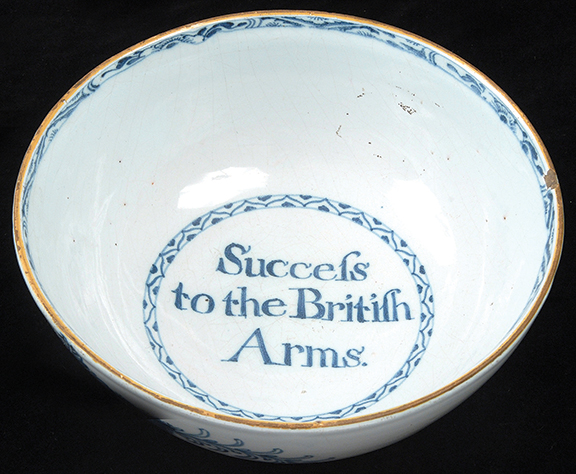
James acquired this tin-enameled earthenware punch bowl, circa 1758, from the collection of William Guthman (1924-2005). Patriotic punch bowls were produced in England during the French and Indian War and “are highly desired by collectors today,” he said.
Originally published in the September 2023 issue of Maine Antique Digest. © 2023 Maine Antique Digest